Causes of Marfan Syndrome
Causes of Marfan syndrome lie within the very fabric of a person’s genetic makeup. This inherited connective tissue disorder results from a mutation in a specific gene, disrupting normal protein production and weakening structural support throughout the body. Understanding the Causes of Marfan syndrome is essential not only for accurate diagnosis but also for managing expectations about disease progression, treatment, and inheritance risks. In this section, we will explore the key mechanisms behind the disorder, including genetic mutations, inheritance patterns, and the role of fibrillin-1 in connective tissue stability.
Genetic Mutation in the FBN1 Gene
The most prominent among the Causes of Marfan syndrome is a mutation in the FBN1 gene on chromosome 15. This gene holds instructions to make fibrillin-1, a protein that builds microfibrils. Microfibrils support elasticity and structure in skin, ligaments, blood vessels, and the lens of the eye. When the FBN1 gene mutates, you see:
- Production of abnormal fibrillin-1 protein
- Disruption in building microfibrils
- Excess activity of TGF‑β due to poor signal control
High TGF‑β levels lead to abnormal growth and shape of connective tissues. That worsens many features of Marfan. These changes show that the Causes of Marfan syndrome involve more than just structure—they reach down to molecular signals.
Inheritance Pattern
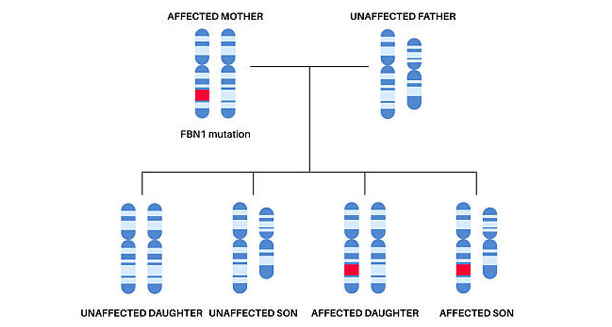
Inheritance plays another key role in the Causes of Marfan syndrome. The disorder works in an autosomal dominant pattern. That means one copy of the bad gene from either parent causes the condition. Key points:
- A child has a 50% chance of inheriting the disorder if one parent carries the mutation
- Both males and females face equal risk
- Some with the mutation show few or mild symptoms
About 75% of cases come from a parent with Marfan syndrome. In the other 25%, the mutation arises spontaneously (de novo). Even spontaneous cases can then pass the mutated gene to next generations.
Sporadic Mutations (De Novo Cases)
In many cases, the Causes of Marfan syndrome include de novo mutations. These mutations occur at conception or early embryo growth. Neither parent shows signs, yet the child carries a faulty FBN1 gene. That child can also pass the mutation to their own children. Although spontaneous, these cases still show the same structural and functional damage seen in inherited ones. Clinicians must treat them with equal seriousness.
Role of Fibrillin‑1 and Connective Tissue
To grasp the Causes of Marfan syndrome, one must see how fibrillin‑1 works. Fibrillin‑1:
- Binds with other proteins to build microfibrils, which act like scaffolding
- Controls TGF‑β levels, stopping excess tissue growth or scarring
- Gives tissues flexibility and bounce
When fibrillin‑1 fails, tissues lose stretch and recoil ability. They grow weak under pressure. That failure explains risks such as aortic aneurysm, lens dislocation, or joint problems.
Environmental and Epigenetic Influences
Although genes cause Marfan syndrome, external factors may affect how bad the symptoms become. These factors include:
- Nutrition
- Exercise habits
- Hormone levels
- Inflammation
These do not cause Marfan syndrome directly. However, they can worsen joint pain or stress the heart. Epigenetic changes—shifts in gene expression without DNA change—may also play some role. This area remains under study, so it is not yet part of standard causal models.
Associated Genetic Disorders
Many disorders look like Marfan syndrome but come from different genes. Doctors must tell them apart. For example:
- Ehlers‑Danlos Syndrome (EDS) affects collagen, not fibrillin
- Loeys‑Dietz Syndrome (LDS) stems from mutations in TGFBR1 or TGFBR2
- Homocystinuria mimics some signs but comes from metabolic defects
Differentiation matters because management, treatments, and outlook differ. Genetic testing and clinical review help in this.
Genetic Testing and Family Screening
Given how inheritable the Causes of Marfan syndrome are, genetic counselling and testing matter greatly. Testing the FBN1 gene in someone affected lets families:
- Confirm diagnosis
- Identify at‑risk family members
- Make informed family planning choices
In some instances, prenatal genetic testing can provide early information. If one parent carries the FBN1 mutation, prospective parents gain insights and options ahead of time.
Summary: What Drives the Causes of Marfan syndrome
The Causes of Marfan syndrome stem from a mutation in a single gene, FBN1, which undermines fibrillin‑1 production. Whether inherited or spontaneous, this mutation weakens connective tissue across many systems. By knowing how the gene works and how the disorder passes on, people and doctors can plan early, monitor closely, and adapt lifestyle. Genetic testing, early diagnosis, and awareness remain central tools in handling what Causes of Marfan syndrome bring.