
Overview of Macular Degeneration
Macular degeneration — also known as age-related macular degeneration (AMD) — is a common eye condition that affects central vision. It damages the macula, which is the part of the retina responsible for sharp, straight-ahead vision. People with macular degeneration may struggle with reading, recognising faces, or driving.
While peripheral (side) vision usually stays intact, the loss of central vision can be life-changing. Macular degeneration is one of the leading causes of vision loss in people over 50, especially in developed countries. As the global population ages, the number of people affected by AMD continues to rise. That’s why early detection and treatment are more important than ever.
Understanding the Retina and the Macula
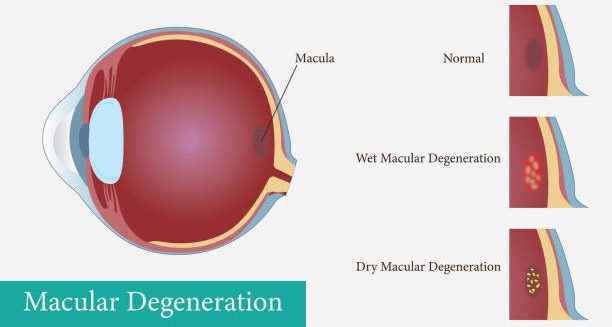
The retina is a thin, light-sensitive layer at the back of the eye. It turns light into signals that the brain uses to create visual images. At the very centre of the retina is the macula — a small area that gives us clear, detailed vision.
When the macula becomes damaged, people lose the ability to see fine details. While they won’t go completely blind, they may no longer be able to read, drive, or recognise faces clearly.
Types of Macular Degeneration
There are two main types of macular degeneration: dry and wet.
Dry Macular Degeneration
This is the most common type. It makes up about 85–90% of AMD cases. Dry AMD happens when the macula gets thinner with age. Yellow deposits called drusen also build up under the retina.
- Causes slow, gradual vision loss
- Often affects both eyes
- May stay stable for years in early stages
Wet Macular Degeneration
Wet AMD is less common but more serious. It occurs when abnormal blood vessels grow under the retina and leak blood or fluid. This damages the macula quickly.
- Can cause sudden vision loss
- May lead to permanent damage if not treated
- Often develops from dry AMD
Wet AMD is a medical emergency. Fast treatment can help preserve vision and sometimes even improve it.
Early Signs and How It Progresses
In the early stages, macular degeneration may not cause any symptoms. Many people don’t notice anything until their vision starts to change.
As the disease progresses, symptoms can include:
- Blurry or distorted central vision
- Trouble recognising faces
- Straight lines appearing wavy
- A dark or empty spot in the centre of vision
- Faded colours or reduced contrast
Dry AMD progresses slowly, while wet AMD can get worse very quickly.
Who Is at Risk for Macular Degeneration?
Some people are more likely to develop AMD than others. The biggest risk factor is age, but many other factors can also play a role.
Common risk factors include:
- Age over 50
- Family history or certain genes
- Smoking
- Obesity
- High blood pressure or heart disease
- Long-term sun exposure
- A poor diet low in antioxidants
The good news is that many of these risks can be reduced with healthy lifestyle choices.
Why Early Detection Is So Important
Catching macular degeneration early makes a big difference. While there is no cure for dry AMD, taking the right vitamins can slow its progression. Wet AMD can be treated with injections that help stop vision loss — and sometimes even improve it — if given early.
Everyone over 50, or anyone at risk, should have a dilated eye exam once a year. Using tools like the Amsler grid at home can also help track changes in vision between appointments.
Living with Macular Degeneration
Losing central vision can affect every part of daily life. It may lead to:
- Difficulty reading or writing
- Loss of ability to drive
- Trouble with work or hobbies
- Feelings of frustration or depression
Fortunately, there are many ways to adapt. Vision aids, counselling, and support groups can help people stay independent and improve their quality of life.
Summary
Macular degeneration is a serious eye condition that affects the part of the retina responsible for sharp vision. It mostly affects older adults and can lead to the loss of central vision over time. While it doesn’t cause complete blindness, it can make everyday tasks difficult.
Early diagnosis and treatment are key. With proper care, many people with AMD can maintain their independence and enjoy a good quality of life.