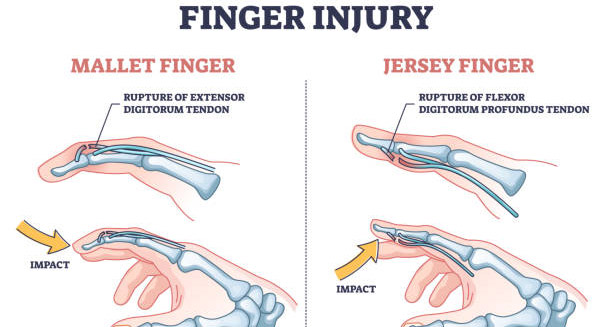

Mallet finger is a specific and often underestimated hand injury that results from damage to the extensor tendon on the back of the finger.
This tendon straightens the fingertip. When injured, the fingertip droops and cannot straighten on its own. Often, the injury comes from trauma, such as a ball striking the finger tip or a sudden knock during daily tasks. If ignored or managed poorly, mallet finger can leave lasting problems with hand function.
The name “mallet finger” comes from the bent shape of the fingertip. It points downward like the head of a mallet. In medicine, it is called an “extensor tendon injury” or a “terminal extensor tendon rupture.” This means the tendon cannot pull the last joint into extension.
Mallet finger is common in both athletes and non-athletes. Still, many people do not seek care right away because the injury often looks mild.
Anatomy Behind Mallet Finger
To understand mallet finger, we need to look at finger anatomy. The extensor tendon runs along the back of the finger and attaches to the distal phalanx, which is the tip bone. When the finger bends suddenly while the tendon is tight, the tendon may tear. Sometimes, a piece of bone also breaks off with the tendon. This is called a bony mallet finger.
This injury often affects the middle, ring, or little fingers. Both children and adults can get it. However, middle-aged men in ball sports or heavy manual work face the highest risk. Everyday incidents also cause mallet finger. For example, closing a drawer, tucking in a blanket, or catching a finger on clothing.
Types and Classifications of Mallet Finger
Doctors divide mallet finger into three main types:
- Tendinous Mallet Finger – the tendon tears, but no bone breaks.
- Bony Mallet Finger – a small piece of bone breaks with the tendon.
- Complex Mallet Finger – the joint partly dislocates or a large bone fragment breaks, which may need surgery.
This classification matters because it guides treatment. Tendon-only injuries often heal with splinting. More complex or bony types may need surgery.
Common Scenarios and Warning Signs
Mallet finger often happens in simple situations. Examples include:
- A cricket ball striking the fingertip.
- A finger caught in a door.
- Pressure from heavy bed sheets.
- Grabbing at a falling object.
Since pain is not always strong, many people think it is just a bruise or sprain. Yet, one clear sign is the drooping fingertip that cannot straighten by itself. When this happens, medical care is urgent.
Other signs may include swelling, redness, bruising, or pain on the back of the finger. Grasping small objects also becomes hard. If untreated, the finger may stiffen or heal wrongly. This can cause a lasting deformity and reduce finger skill, making tasks like typing, writing, or tool use harder.
Importance of Early Diagnosis and Splinting
Unlike fractures, mallet finger does not always look serious. Still, quick diagnosis is vital. Within a few days, the joint tissues stiffen and scar tissue forms. Late treatment lowers the chance of success with simple splinting.
Doctors check the finger with an exam and often an X-ray. If the tendon tears without bone injury, splinting works well. If bone breaks or the joint shifts, surgery may be needed.
Splinting is the main treatment in most cases. The splint keeps the fingertip straight for 6–8 weeks. It is vital that the finger never bends during this time. Even one slip can restart the healing process. Later, patients may wear the splint only at night or during tasks for a few more weeks.
Prevention and Long-Term Outlook
Patient discipline with splinting makes a big difference. If instructions are not followed, the droop may stay or lead to a swan-neck deformity, where the middle joint bends in the wrong way.
Although prevention is not always possible, some steps reduce risk. For example, wearing finger guards in sports, using safety gear at work, keeping fingers strong and flexible, and resting during repetitive hand tasks. Athletes in cricket, baseball, and basketball may also tape or splint vulnerable fingers during play.
With the right care, most people recover well from mallet finger. Many regain full or near-full function. Recovery is slower in older adults or those with arthritis or diabetes. Some may keep a slight droop or small cosmetic change, but early care prevents serious problems.
In short, mallet finger may look like a minor injury, but it needs fast care and strict treatment. Those who follow splinting and rehab can return to normal daily tasks without long-term effects.